
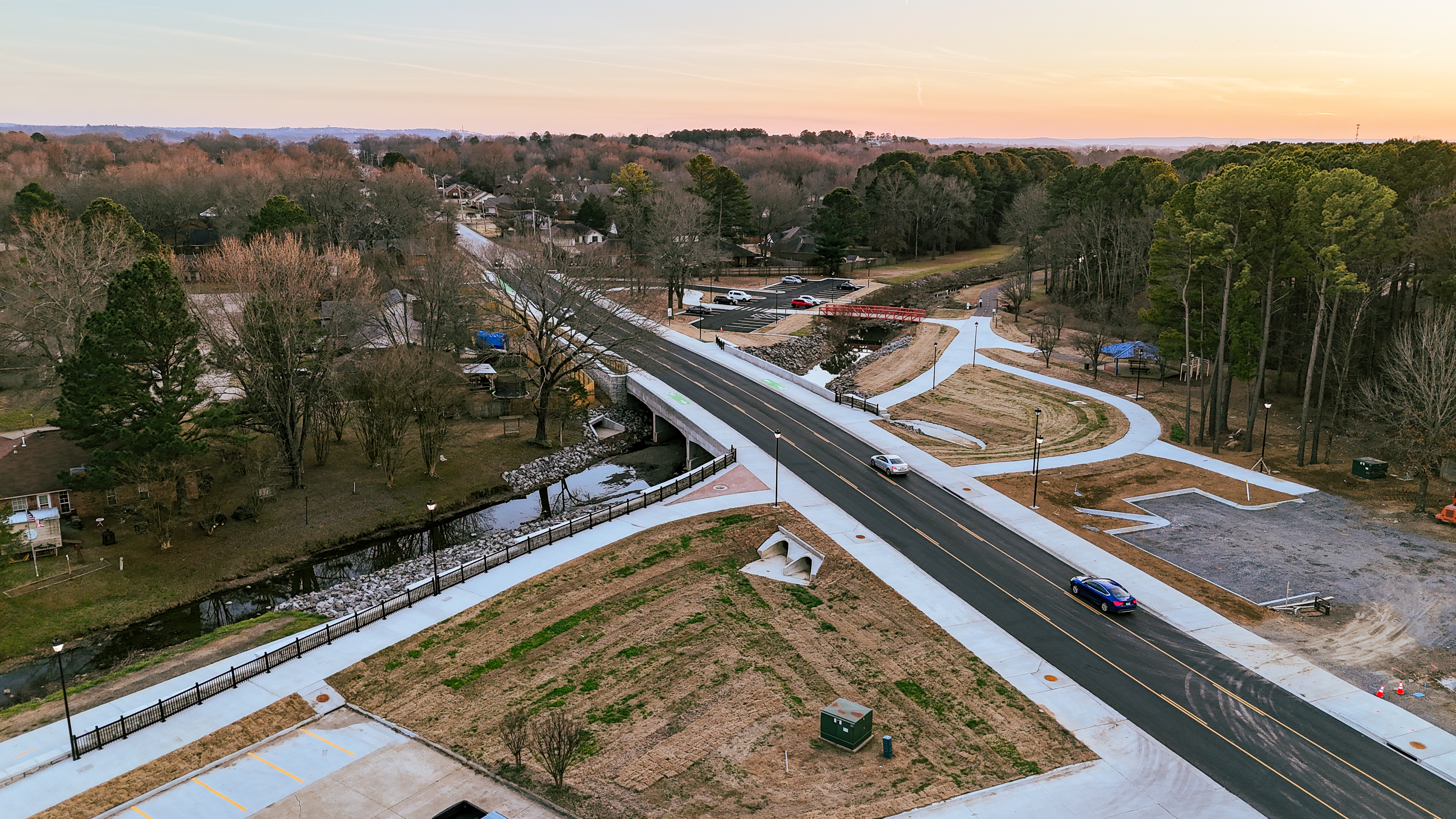
For years, Kinley Trail slowed to a stop at Salem Road as it snaked along Tucker Creek. Walkers, runners, and cyclists reached the edge of the corridor, waited for a gap in traffic, and crossed before continuing on their way. Drivers, meanwhile, often had to slow unexpectedly as trail users moved through the crossing along one of the city’s busier routes.
That friction point is gone.
With the replacement of the Salem Road bridge over Tucker Creek, the trail now passes beneath the roadway, allowing users to remain on the path while separating foot and bike traffic from vehicles above. The change creates a more predictable experience for everyone moving through the corridor — whether on wheels, on foot, or behind the wheel.
“For pedestrians and cyclists, it’s much safer,” City Engineer Kurt Jones said. “For motorists, it’s much smoother because they won’t have to stop or yield for pedestrians and cyclists.”
The bridge itself had reached a point where replacement was necessary. Jones said the previous structure had become too small for the corridor’s future demands and limited the city’s ability to move forward with planned improvements. “The old bridge was undersized and prevented us from being able to widen Salem Road from Dave Ward Drive to College Avenue,” Jones said, adding the bridge “was nearing the end of its operational life.”
Rebuilding it created an opportunity to rethink how the trail intersected with Salem Road. Instead of directing pedestrians and cyclists across traffic, the project introduced an underpass that keeps travel continuous along the Kinley Trail. “This gave us the opportunity to eliminate the at-grade pedestrian and cyclist crossing,” Jones said. “The underpass greatly improves safety for that section of Kinley Trail.”
Just as important is what the underpass restores: momentum. Long or uncomfortable crossings can discourage use, particularly among casual riders or families. Removing that barrier helps make the trail feel more accessible from the start. “It should improve it dramatically since they won’t be required to cross one of the busiest corridors in the city,” Jones said.
City staff expects the shift to build over time as more residents grow familiar with the upgrade. “It will take time for casual users to recognize the improvements, but eventually people will be more likely to utilize the trail for transportation and recreation,” he said.
Comfort, Jones added, is often the deciding factor. “Perception drives behavior more than reality. People are more likely to use any trail if they feel safe and comfortable, particularly by removing friction points at road crossings.”
The Salem Road project also strengthens the Kinley Trail’s role as both a recreation amenity and a viable transportation corridor, improving continuity while reinforcing east-west connectivity across Conway. Shared-use paths included with the bridge and the broader Salem Road improvements are expected to serve as a major segment of Connect Conway.
While the underpass marks a significant step forward, additional work along the corridor is expected to extend those benefits. Salem Road is slated for widening between Dave Ward Drive and College Avenue, a project designed to expand capacity while complementing the shared-use infrastructure already in place. “Also, the full benefit won’t be realized until Salem Road is widened from College Avenue and Dave Ward Drive,” Jones said.
Attention will then shift toward Tucker Creek at College Avenue, where another bridge replacement is planned. Much like the work at Salem Road, the goal is to improve both safety and continuity by reducing the need for trail users to interact with traffic while supporting a growing transportation corridor. The project is expected to include a pedestrian underpass and has received federal funding support. “Eliminating the road crossings will improve continuity and safety,” Jones said. “The full effect will be felt after the College Avenue bridge at Tucker Creek is replaced.”
Taken together, the projects reflect a broader shift toward building trails that function less as stand-alone recreation amenities and more as dependable ways to move through the city — whether the destination is work, school, or a weekend run.


Leave a Reply