
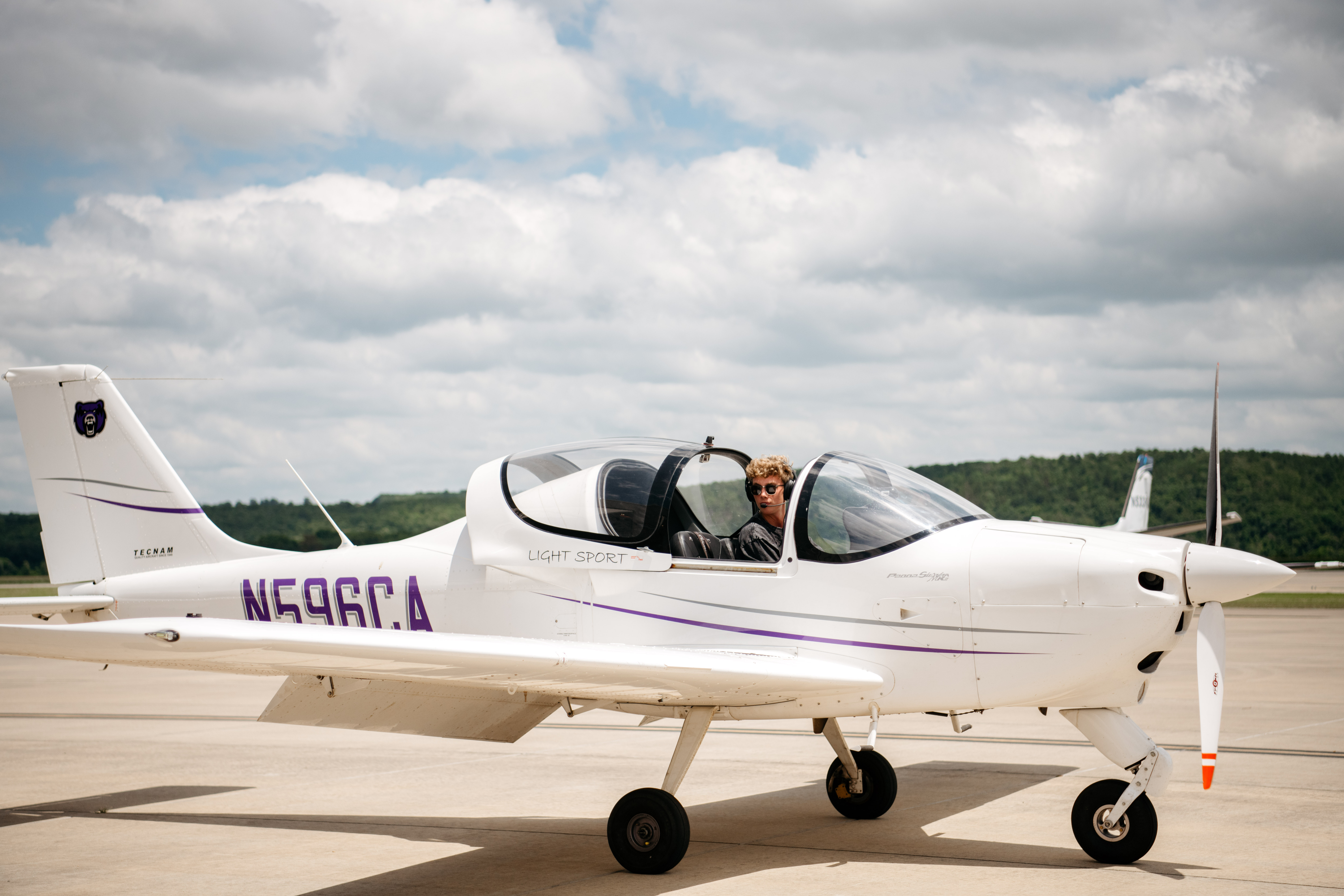
The aviation industry is facing a pilot shortage that is only expected to grow in the coming years and decades. Industry experts say 200,000 pilots will be needed by 2030, and that number could be more than 600,000 pilots by 2040.
The UCA Aviation Academy was started in 2024 to help address this pilot shortage within the state of Arkansas and the broader region. The demand and interest in the program were instantaneous.
“Within a week, we had 500 names,” said Brad Teague, director of the UCA Aviation Academy. “We knew there was a pilot shortage, and we knew a lot of people were interested, but that initial rush was surprising.”
The academy started in March 2024 with 15 students. Since then, it has found its cadence, starting new courses about every three months — in January, April, and September — with a new set of about 15 students, averaging about 50 students throughout the academy at any one time.

The academy offers four certifications, all achievable within about two years. Students begin with the private pilot license, requiring a minimum of 35 flight hours, which permits the holder to fly during visual day and night conditions. From there, they can add an instrument rating, also 35 hours minimum, which allows a pilot to fly without visibility using only cockpit instruments. The commercial license follows, requiring 190 accumulated flight hours, including night flying, cross-country routes, and enhanced maneuvers, and permits a pilot to be compensated for flying. Finally, the multi-engine rating certifies a pilot to operate aircraft with more than one engine, requiring both ground and flight instruction, including demonstrated proficiency flying on a single engine.
Completion of these four licenses and ratings opens opportunities for pilots as charter or taxi air pilots, ferry pilots, cargo and freight pilots, and as a flight instructor.
“When you finish all your certificates with us, you’re at about 300 hours and still need another 1,200 hours to be able to sit for the license as a commercial airline pilot,” Teague said.

To bridge the gap, many pilots become flight instructors to be able to log the hours necessary in a shorter amount of time. The UCA Aviation Academy has had two graduates of the program; one now serves as a flight instructor for the academy, and the other works with the Conway Regional Airport, where he is working on his instructor’s license to also work with the academy.
The academy is taught by flight instructors from Central Flying Academy of Little Rock, a well-known and respected aviation firm in the region. In addition to teaching its students, that partnership has provided a pipeline for academy graduates to find jobs as flight instructors while they work to gain hours to one day become a commercial pilot or further their aviation career in another way.
“Central Flying Academy has been an incredible partner. We could not be as successful as we have without them,” Teague said. “Phil Jordan and Mark Valenzuella get things done for our students. They are great to partner with and are committed to the best instruction possible for our students. “
Another viable partnership has opened with a private jet charter service, Gen 4 Jets, in Newport, that has agreed to hire UCA Aviation Academy graduates for its company. The collaboration establishes a dedicated pilot pipeline program where graduates of the UCA Aviation Academy receive a guaranteed interview with Gen 4 Jets.

“We have connections in a lot of places, so we feel like we can place our graduates so they can be paid to get those hours they need and find opportunities in aviation,” Teague said.
The partnerships with Central Flying Academy, the Newport charter service, and the Conway Regional Airport have been vital to the growth of the academy in its first two years.
“Without the city, the mayor, and the airport director, Jake Briley, we couldn’t have done what we have,” Teague said. “They have been extremely helpful. Every time I ask Jake for something, it’s always ‘yes.’”
Briley said UCA has been a great partner for the city and the local airport, and he is excited to see a new avenue for people to enter aviation. Specifically, Briley appreciated the opportunity for students to complete the aviation academy while enrolled at UCA in a separate degree field.
“I know a few who work for me are getting their degrees in areas like business, and that’s amazing,” Briley said. “It allows them other options, instead of just getting a general aviation degree and going through a traditional four-year aviation program. They can be done within two years, start earning money, and can advance in their aviation careers.”
The academy has also grown in terms of physical space, celebrating the groundbreaking and opening of its own hangar last year.
The aviation academy opened a 10,000-square-foot hangar in 2025. The hangar features 8,000 square feet for aircraft and 2,000 square feet for flight simulators, classrooms, and offices.
“Having our own dedicated space has been extremely beneficial,” Teague said. “When I see our students back here with our instructors, and especially the first time they walk in here, you see their faces kind of light up. They see the simulators, they see the workspace, they walk in the hangar, and it just hits them that this is real.”
Two years into the academy, Teague said he is focused on continuing to grow the aviation program, providing more financial aid to students, and deepening the pipeline for graduates.
“Our biggest obstacle right now is affordability,” he said. “Our biggest goal is finding ways to help our students more financially.”
The academy was recently awarded the Arkansas Workforce Challenge Grant, which will now provide up to $3,000 for eligible students.
“We have worked with the UCA Foundation to raise money for scholarships now available for the private pilot license, as well,” Teague said. “We also have some new $2,500 scholarships available, and we were just approved by Sallie Mae for student loans.”
As the program continues to grow and mature, Teague said he remains focused on helping to address a pilot shortage that sparked the idea for the UCA Aviation Academy and to offer aviation as a career to more Arkansans.
“We got into this space to help with the pilot shortage, which is only going to increase in the coming years, and we also want to see the UCA footprint continue to grow and in what is a completely new direction,” Teague said. “As we get more years under our belt, we’re going to start seeing more of our graduates in the industry and making a tremendous impact.”




Leave a Reply